The ArtFlow Project
A creative wellbeing service, designed to be safe
I created ArtFlow, mindfulness-based art-making sessions for adults living with stress, and I design and facilitate them. Over 20 sessions, in person and online, I built the service end to end, then co-designed it with practitioners to find where a session could leave someone worse off, and turned what we found into design decisions.
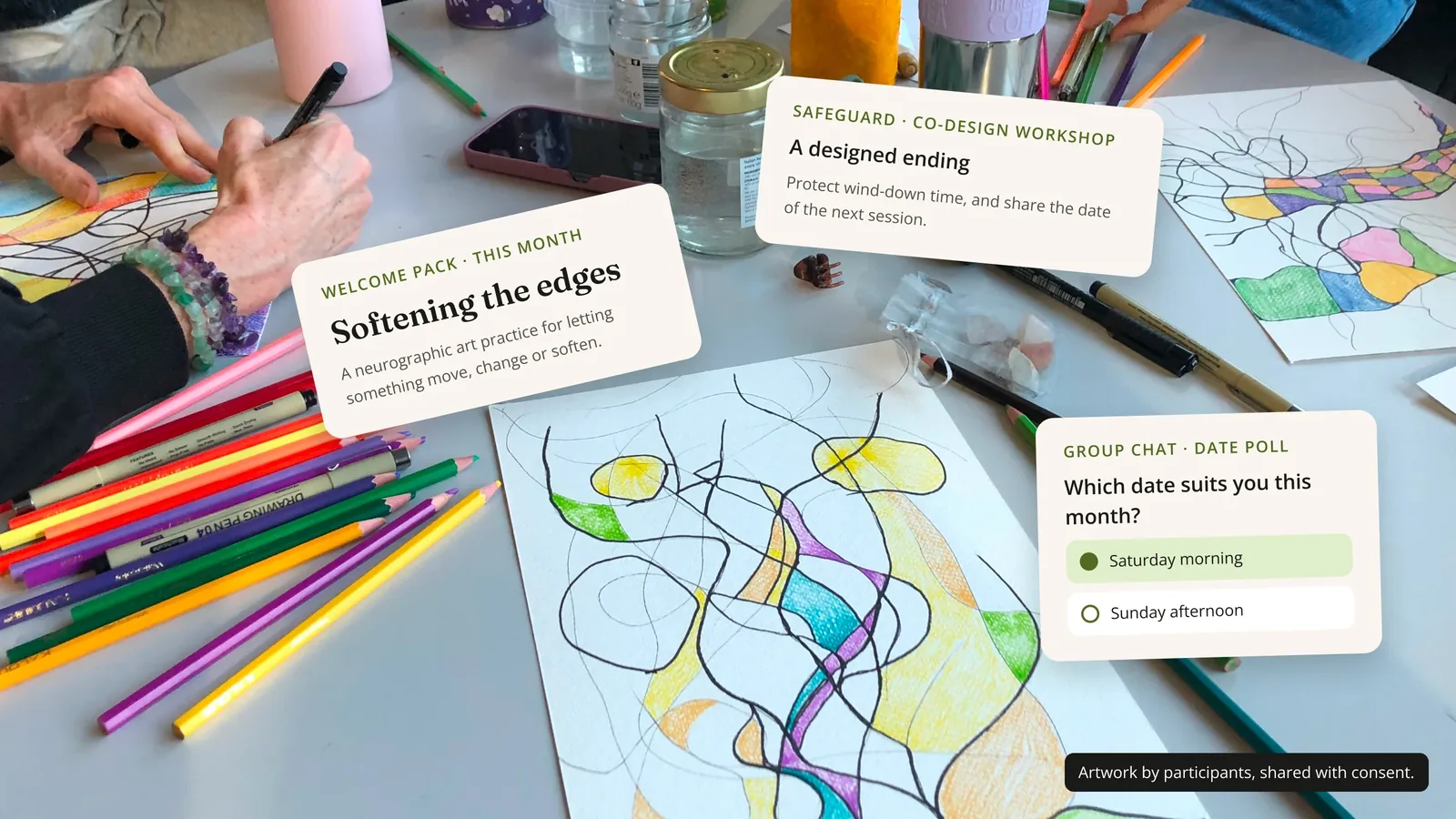
At a glance
The problem
Stress, perfectionism, and a practice that needed designing with care
Work-related stress is the biggest cause of work-related ill health in Great Britain: in 2024/25, 964,000 workers reported work-related stress, depression or anxiety (HSE, 2025).
I know it from the inside. As a designer, I've lived with stress, burnout and the perfectionism that feeds them. Mindfulness and art-making helped me create for its own sake again, and I trained in art therapy-informed practice so I could share that with others.
Sharing it safely was the hard part. ArtFlow isn't therapy, and I couldn't find any research on how non-clinical, mindfulness-based sessions with general adults can cause harm.
How might I offer a creative, mindfulness-based practice that helps adults under stress reconnect with their creativity without becoming another place to perform or being mistaken for therapy?
The question behind the project
At a glanceWhy I started ArtFlow, and how I designed it to be safe
Problem: work-related stress is the biggest cause of work-related ill health in Great Britain. Creative, mindfulness-based practice can help, but outside clinical art therapy, there's no guidance on how a session can cause harm.
My role: creator, designer and facilitator. I run every session and own the research and the decisions, with volunteer collaborators when needed.
What I did: designed a two-track service (in person and online) end to end, built a feedback loop, defined ideal customer profiles and a pay-as-you-can model with participants, and ran a co-design workshop with five practitioners and participants to map emotional harms.
What changed: the workshop showed that most safeguards are design decisions made before a session starts. I changed how ArtFlow is named and described across the whole service, and I'm redesigning the opening, the ending and my own language around the top harms.
My role and the team
From sessions for friends to a designed service
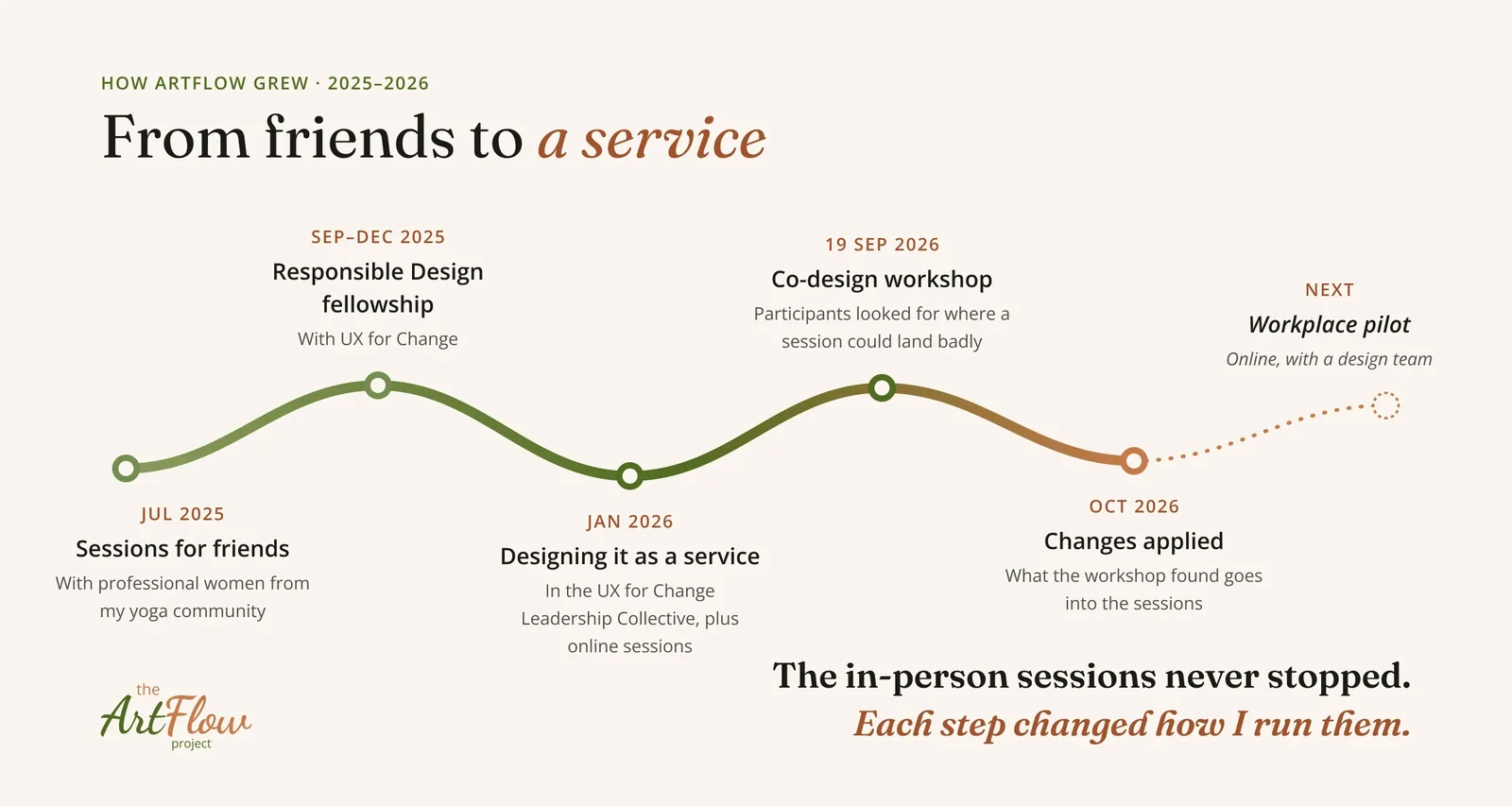
ArtFlow began in July 2025 as sessions for a group of friends to reconnect and build my facilitation experience before the Responsible Design for Change Fellowship. Their kind donations through a crowdfunding page, helped fund my fellowship studies. The fellowship left me with a question: how can designers be more responsible in their role? My responsible design coach, Cecilia Scolaro, suggested it starts with yourself: reconnecting with your body, heart and mind, and acknowledging your positionality, biases and limits before reaching outward. That became ArtFlow's foundation and pivot moment: guiding people to reconnect with their creativity and build self-awareness through art therapy-informed practice, valuing the process over the finished piece.
Making a dream come trueMy role and constraints
My role: Creator, designer and facilitator. I design the service, run every session, and own the research and the decisions.
Collaborators, not a team. Volunteers from the UX for Change Collective join when needed, like my steward, Rayya, who took notes at the co-design workshop.
Constraints. One facilitator; funded by what participants give; two tracks, in person and online; and a line I don't cross: I'm an art therapy-trained facilitator, not an art therapist.
From January 2026, in UX for Change's Leadership Collective, I started treating ArtFlow as a service to design, with coaching for Sandra González on positioning and business model.
The session, and how I listen
One session arc, two tracks
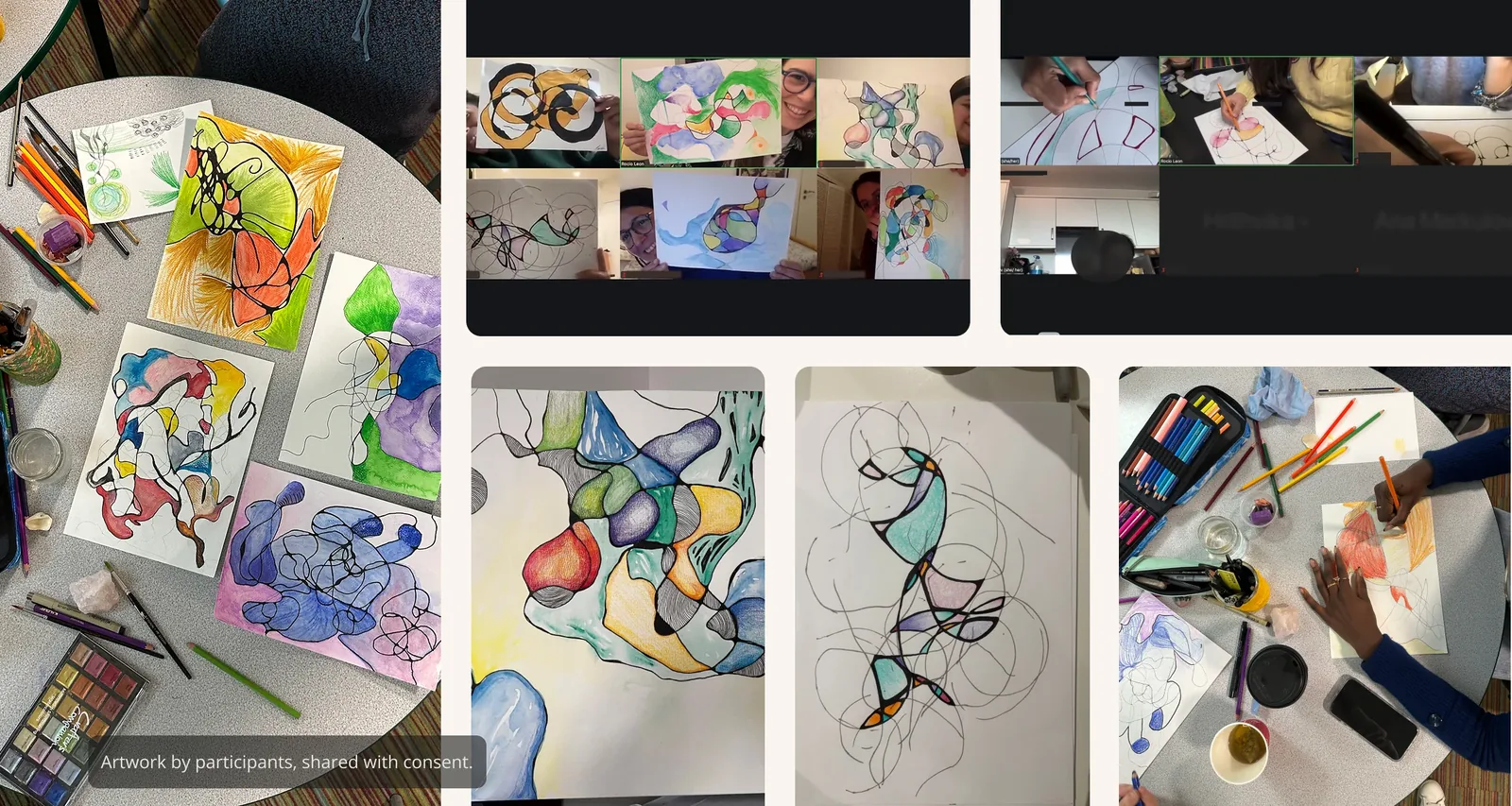
Every session follows the same arc: a welcome and around five minutes of grounding, a warm-up with the materials and the month's intention, the main creation, an optional show and tell, and a closing moment.
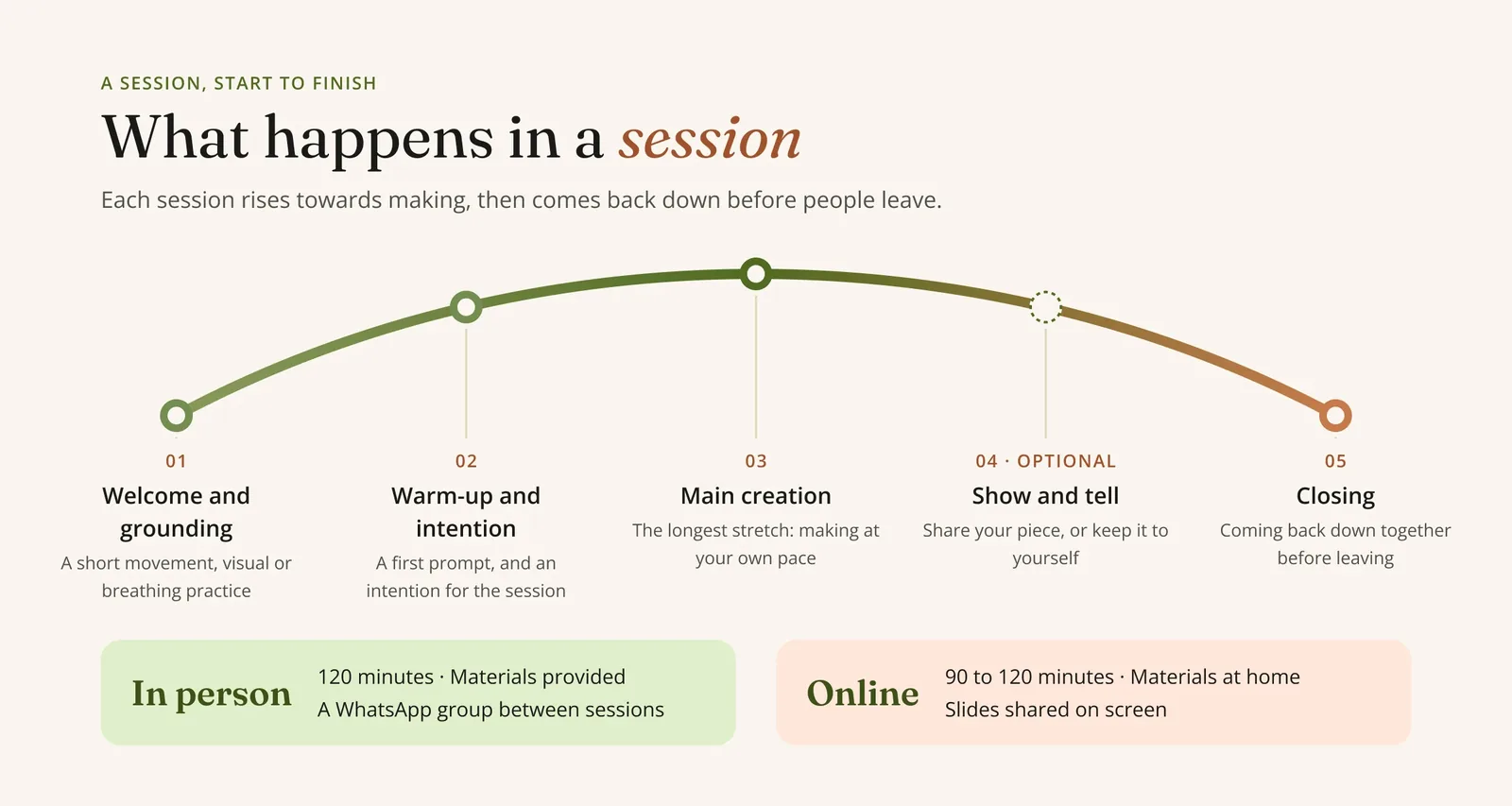
- In person: 120 minutes, usually twice a month, for groups of two to four, with all the materials provided.
- Online: people use what they have at home. I ran one session at 120 minutes and one at 90 minutes.
A feedback loop, not a one-off survey
Online, a pre-session form shapes the session, and a post-session form collects reflections. In person, the WhatsApp group carries photos and reactions after each session. Across the two online sessions, 12 participants gave 14 responses, which I clustered into three questions: who comes, why they come, and how the session needs to run.
The trade-off of two tracks
In person, I can read the room, but what people say in a group may differ from what they would say privately. Online gives more structure and privacy, but I can't see silence. That gap led to the co-design workshop.
The archetypes behind ArtFlowHow I mapped my practice to the DesignShifts archetypes and reflected on my practice
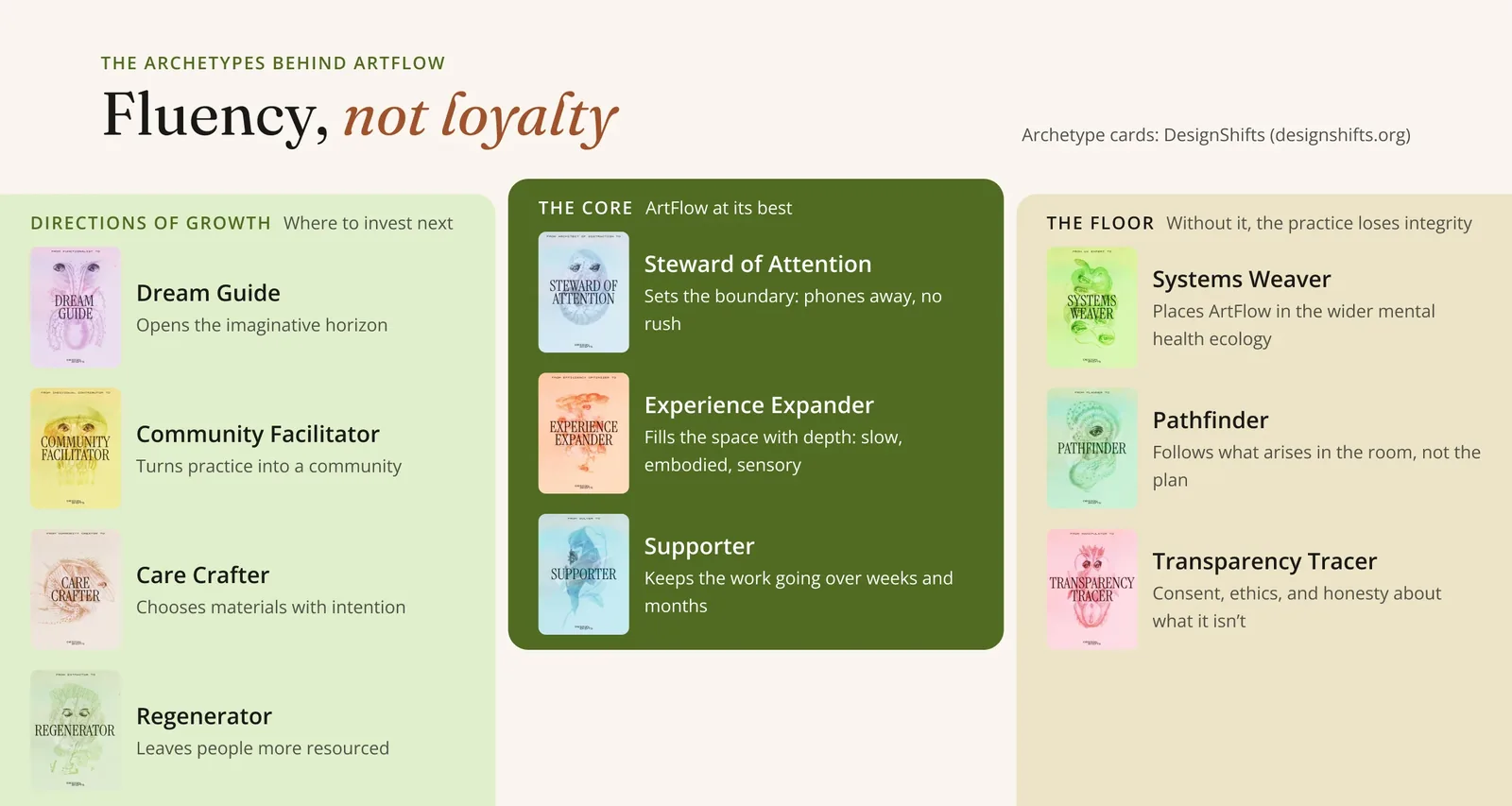
The DesignShifts archetypes aren't boxes to claim. They're transitional postures: invitations to step out of an inherited role and into a more honest one. The aim is fluency, not loyalty. I grouped them by the role they play in ArtFlow:
- The core: Steward of Attention, Experience Expander, Supporter. Together they name what ArtFlow does at its best. The Steward of Attention sets the boundary (phones away, no rush). The Experience Expander fills the space with depth (slow looking, careful materials, embodied prompts). The Supporter keeps the work going over weeks and months. When these three are weak, sessions feel like classes; when they're strong, sessions feel like home.
- Directions of growth: Dream Guide, Community Facilitator, Care Crafter, Regenerator. They extend the work outward: opening the imaginative horizon, turning individual practice into a community, choosing materials with intention, and leaving people more resourced than they arrived.
- The floor: Systems Weaver, Pathfinder, Transparency Tracer. The quieter, structural archetypes. Systems Weaver places ArtFlow inside the wider mental health ecology. Pathfinder gives the facilitator permission to follow what arises in the room rather than the plan. Transparency Tracer governs how the practice presents itself: consent, ethics, and honesty about what it is and isn't. Without them, the practice loses integrity.
Art therapy is, by nature, a Pathfinder discipline: Shaun McNiff's "trust the process". The facilitator sets a container of materials, prompt and time, then walks alongside whatever arises.
Reflecting on my practice
At the end of the UX for Change Leadership Collective's first cohort, I reflected on ArtFlow through the DesignShifts archetypes: shifts in how designers can work, which I read through an art therapy lens. Three describe ArtFlow at its best: the Steward of Attention, the Experience Expander and the Supporter.
"The useful question wasn't 'Which archetype am I?' but 'Which archetype does this session need today?'"
It led to three changes:
- Fewer, clearer emails (Steward of Attention). Six emails before an online session competed for people's attention, so I cut them to three, each with a clear purpose.
- Sharing the session before it happens (Transparency Tracer). In-person participants told me that not knowing the activity in advance caused uncertainty and anxiety. I started sharing the theme and the steps beforehand, which became the Welcome Pack and session materials for the online track.
- A shorter online session. I cut it from 120 to 90 minutes to ease screen fatigue. But in that session, we ran out of time, and some participants left without a proper closing.
I shared these learnings with the Collective on my LinkedIn reflection. That reflection still describes the practice as mindfulness-based art therapy (MBAT). After the co-design workshop, I'm amending language like this across the whole experience and its materials (see Chapter 6), so the reflection also shows the feedback loop at work: learning, then acting on it.
The service
Who it's for, and the journey around the session
I built an empathy map grounded in 12 real participants. It led to two ideal customer profiles.
- Adult women managing stress, who come for themselves.
- Workplace teams, as an alternative to standard team-building. This one is a hypothesis I haven't tested yet.
The value proposition
ArtFlow creates the conditions for your creativity to thrive, combining mindfulness and creative practices to cultivate presence, self-awareness, and joy. It's not therapy or treatment.
We don't give you creativity. We hold the space for you to remove what was covering it.
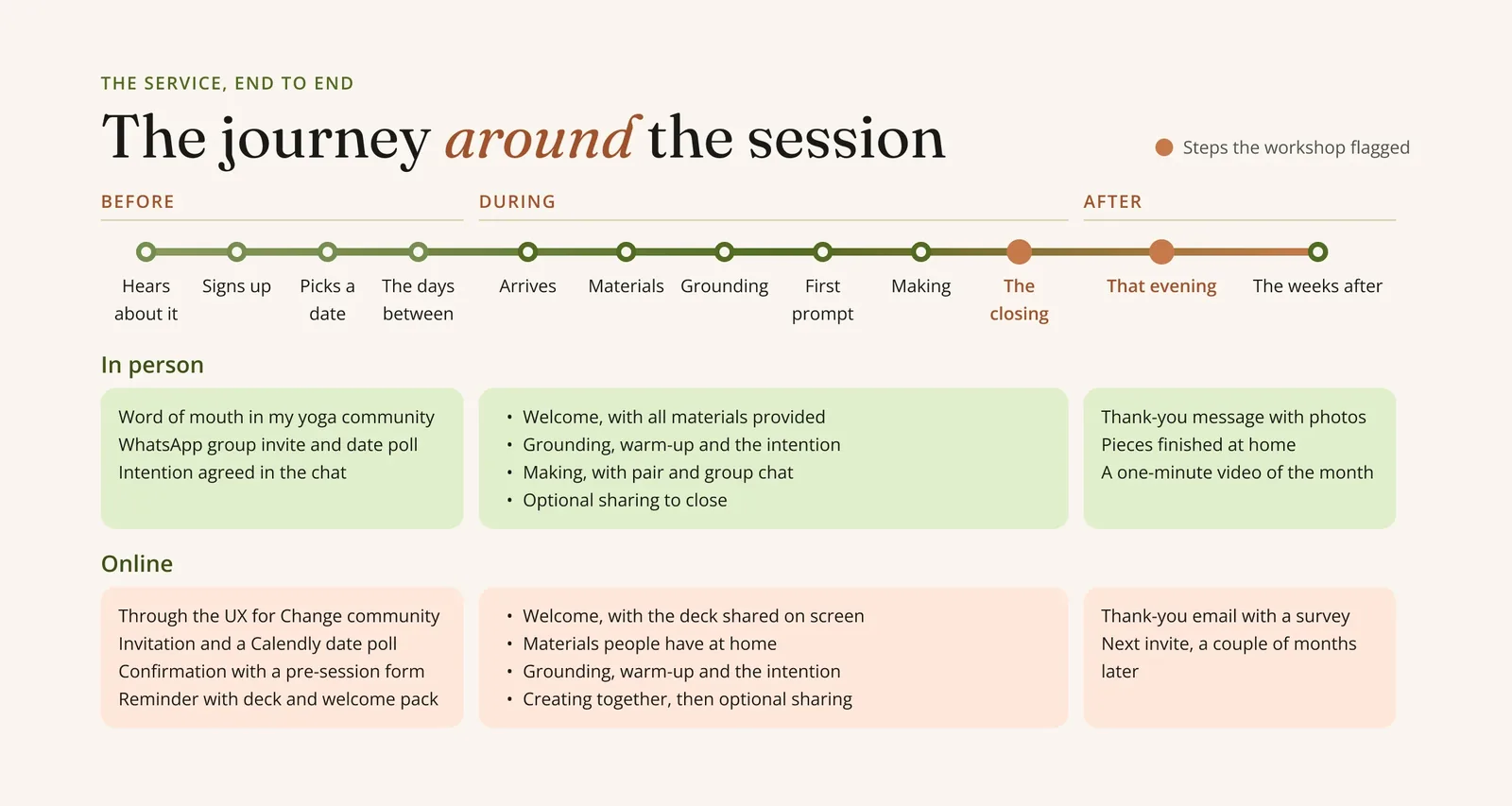
The journey, end to end
The session is one step in twelve, from hearing about it to the weeks after. Several of the emotional harms the workshop found sit either side of the session: in what people expect beforehand and how they're left afterwards.
Making it last
Alongside the service, I explored a sustainable model. I set pricing with participants to keep sessions accessible to people under stress. I'm happy to talk through the model in person.
Co-designing with the field
Finding where a session could leave someone worse off
As a facilitator, I kept noticing moments I couldn't explain:
- Somewhere after the first prompt, I lose people, and I don't find out why.
- Participants compare their work: "I didn't know what to do", "mine is not as good as yours".
- I ran over time, and people had to leave without a group closing.
- Someone left feeling worse than when they arrived.
The service needed the voices of the system it's meant to serve, so I organised ArtFlow's first participatory co-design workshop, online, on Saturday 19 September 2026: five participants, facilitated by me, with my steward taking notes.
Reflection pointWhy I decided to postpone the August date
The workshop was first scheduled for August. By then, no head of design and no therapy or psychology voices had joined.
The point of the workshop was to test the service against perspectives I don't hold, so running it without them wouldn't add the value it needed. I postponed it and ran it in September with the full mix.
Canvas & Consciousness: the workshop's goal
To find where an ArtFlow session could unintentionally cause emotional harm, online and in person, and agree how a facilitator should notice and respond.
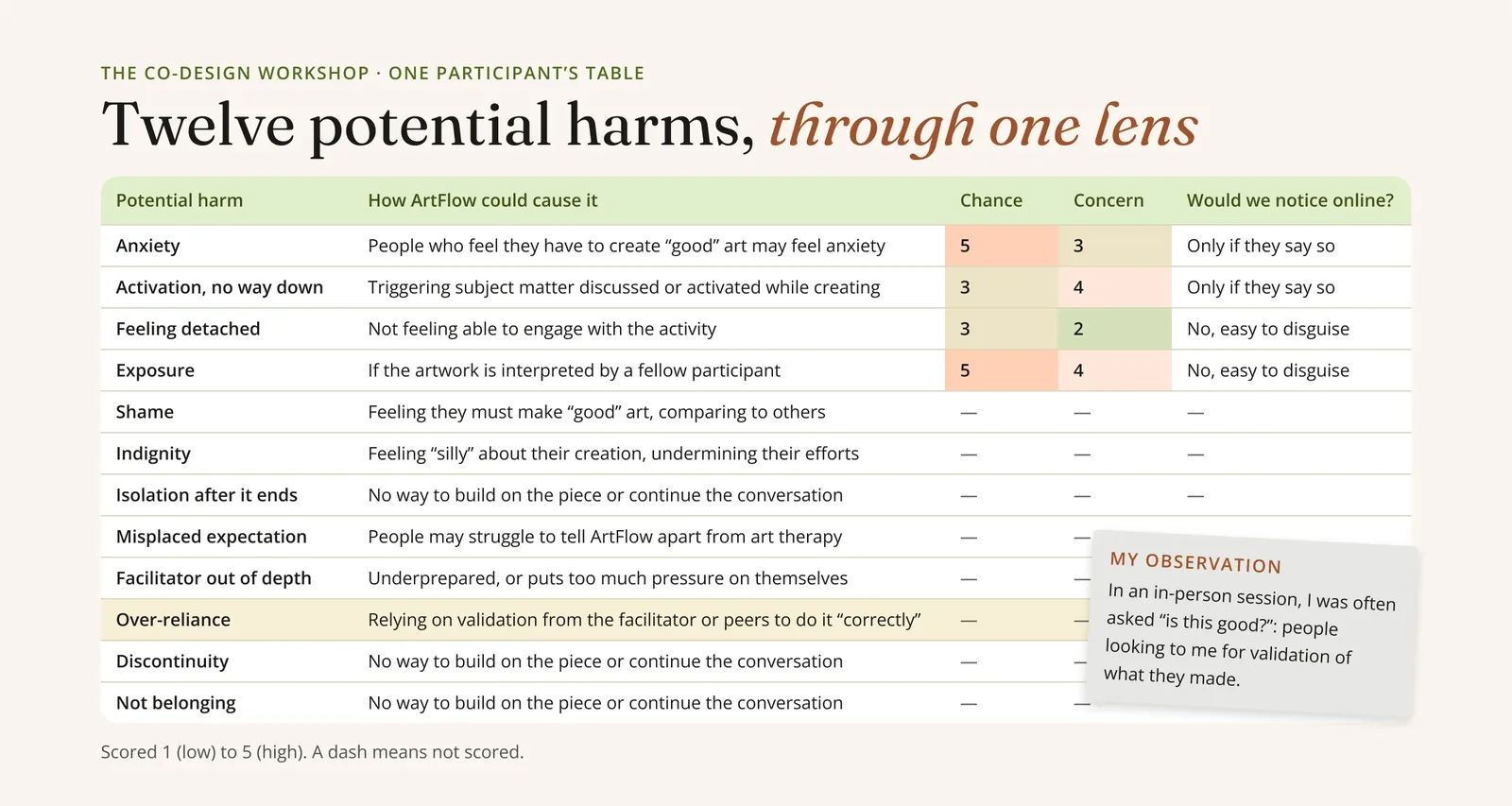
Defining harm before mapping it. Harms is something that leaves someone worse off than when they arrived: more exposed, more ashamed, more alone or more overwhelmed, with no way back down. Harm isn't the same as discomfort. Discomfort is often the work. Harm is what's left when there's no route through.
Who joined, the format, the agenda, and what we didn't reach.How the workshop ran
The evidence gap. An NHS-commissioned systematic review reports harms in clinical art therapy with unwell populations. I couldn't find anything on non-clinical, mindfulness-based art-making with general adults, so I had to work this out with practitioners rather than read it off a list.
The method. For each potential effect, participants gave an example of how ArtFlow could cause it, scored its chance and its level of concern from 1 to 5, and said whether it would be noticed online.
Who was in the room: a regular in-person participant; a facilitator with twenty years in yoga and somatic practice; a participant who had joined both formats, with a psychology degree and art therapy training; an in-person participant who researches responsible design; and a head of product design who leads teams building digital mental health products. They volunteered a Saturday afternoon, and their insights reshaped future sessions.
Format: Google Meet with one shared FigJam board, a zone for each participant. I facilitated, with my steward taking notes. Not recorded, and no art-making. Participants were pre-briefed five days before and received a free ArtFlow session as thanks.
What we did: a grounding exercise, a mirror-drawing warm-up and a one-word check-in; a walkthrough of the current journey, in person and online, with the harms research behind it; the harm mapping and scoring; a response protocol for the top three harms; and a breathing exercise and one-word check-out.
What we didn't reach: the safeguard commitments and the horizon cards. I'd flagged that the agenda was ambitious and chose not to rush the discussion. Participants appreciated it.
Safety by design
What the workshop found
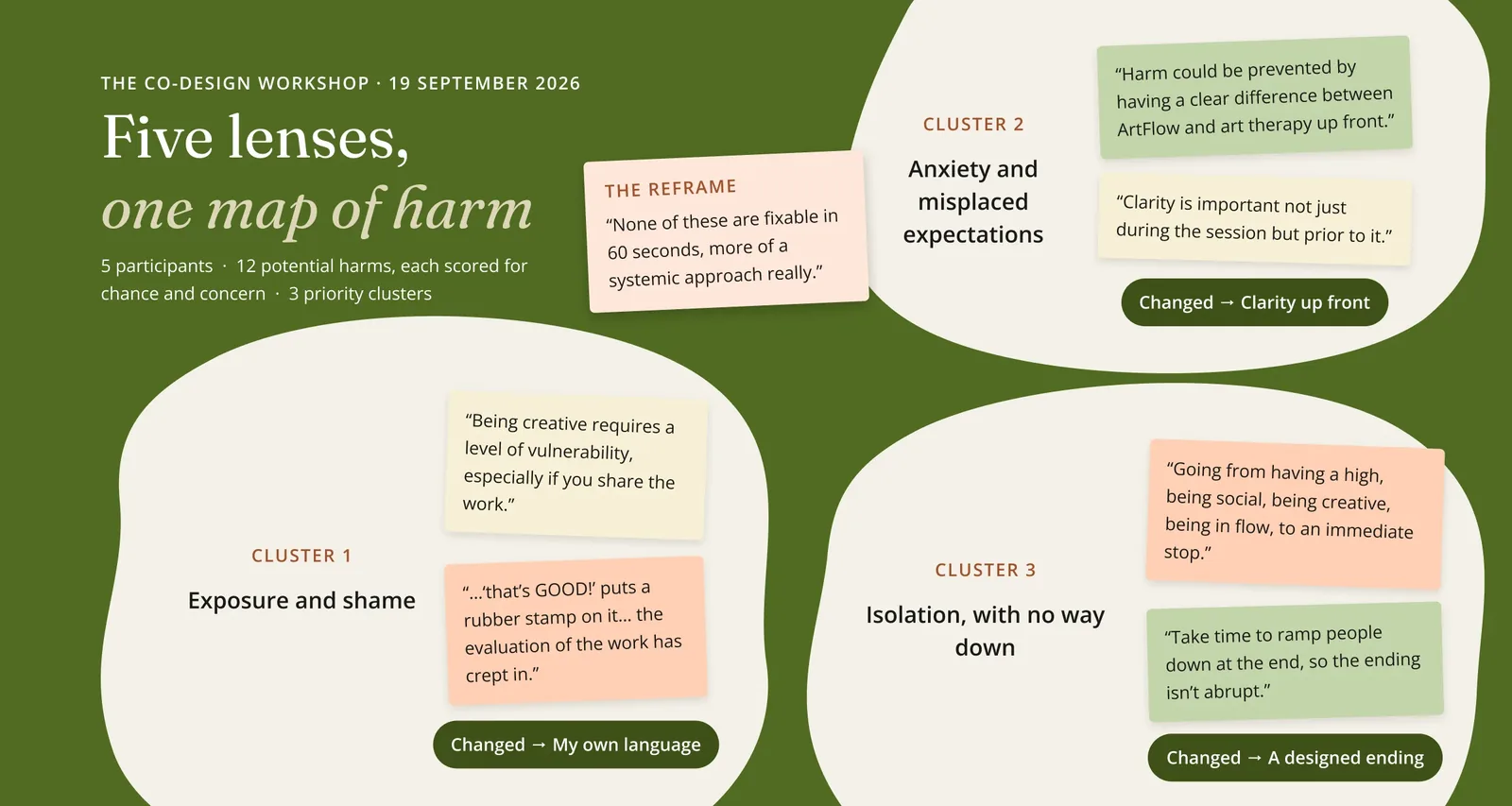
Harms overlap and trigger each other, so we grouped them. The three clusters that scored highest:
- Exposure and shame: feeling judged when your work is interpreted, comparison and perfectionism ("I'm not good at this"), and evaluation creeping in through well-meant praise ("that's good!").
- Anxiety and misplaced expectations: being new and unsure what to do, an unclear goal or structure, buried feelings surfacing, and not knowing how ArtFlow differs from art therapy.
- Isolation and activation with no way down: an abrupt stop after a creative, social high, no way to continue the piece or the conversation, and feeling alone even inside the group.
Indignity, facilitator out of depth and over-reliance were discussed but not scored.
The biggest shift was in how to respond. One participant wrote that none of these could be fixed in sixty seconds: "more of a systemic approach really". Most safeguards are design decisions made before a session starts, and online, where harm is easy to hide, they have to be built into the structure. That reframed the question for me, from response to design.
Naming the thing correctly
I first described the sessions as art therapy. But "art therapist" is a protected title in the UK, held by HCPC registrants, and my training is a CPD-level art therapy course. That makes me an art therapy-trained facilitator, not an art therapist. I changed the language across the whole service, because someone arriving expecting treatment is at risk in a way the session isn't designed to hold.
One participant said plainly:
"I think a lot of potential harm could be prevented by participants understanding the difference between ArtFlow and Art Therapy up front."
Four changes, each answering a cluster
Clarity, endings and language each reduce several harms at once, so the changes start before the session does. I'm applying them to sessions from October 2026.
- Clarity up front (anxiety and misplaced expectations). State the goal, the structure and the roles in the pre-brief and the welcome, and keep the goal visible during the session: in the chat online, on a screen in person.
- A designed ending (isolation and activation with no way down). Protect wind-down time, say what happens after the session, and give the date of the next one.
- My own language (exposure and shame). Remove evaluative praise, and set an expectation for how participants respond to each other's work.
- Check-ins that don't single anyone out (harms hidden online). Use a word or emoji at fixed points in the online structure, and if someone seems to be struggling, check in with them privately rather than in front of the group.
Outcomes and evidence
What people do after a session
Attendance says people came; what they do afterwards says more.
- They come back. In the in-person group of 12, on average, five people return for at least one session a month.
- It travelled. One fellow in the UX for Change Collective made art part of her mindful self-care practice, and the director, Sandra Gonzalez, was inspired by ArtFlow to organise the event, AI Series: An Exploration of Human Expression and its future, which Cecilia Scolaro facilitated.
- Others noticed. My responsible design coach featured the ArtFlow project in Radical Imaginations of the Futures.
In their words
I've really valued Rocio's ArtFlow sessions, which thoughtfully combine art-making, mindfulness and wellbeing. She has shown strong strategic thinking by applying responsible and regenerative design principles to a creative practice in a way that feels accessible, meaningful and effective for reducing burnout. She is a warm and effective facilitator in co-design workshops, keeping a productive pace despite limited time. She is also a quick learner, rapidly adopting harms workshop approaches and progressing from supporting sessions to confidently designing and facilitating workshops independently. For me, Rocio's superpower is her thoughtful passion, leaving every interaction with her feeling energised.
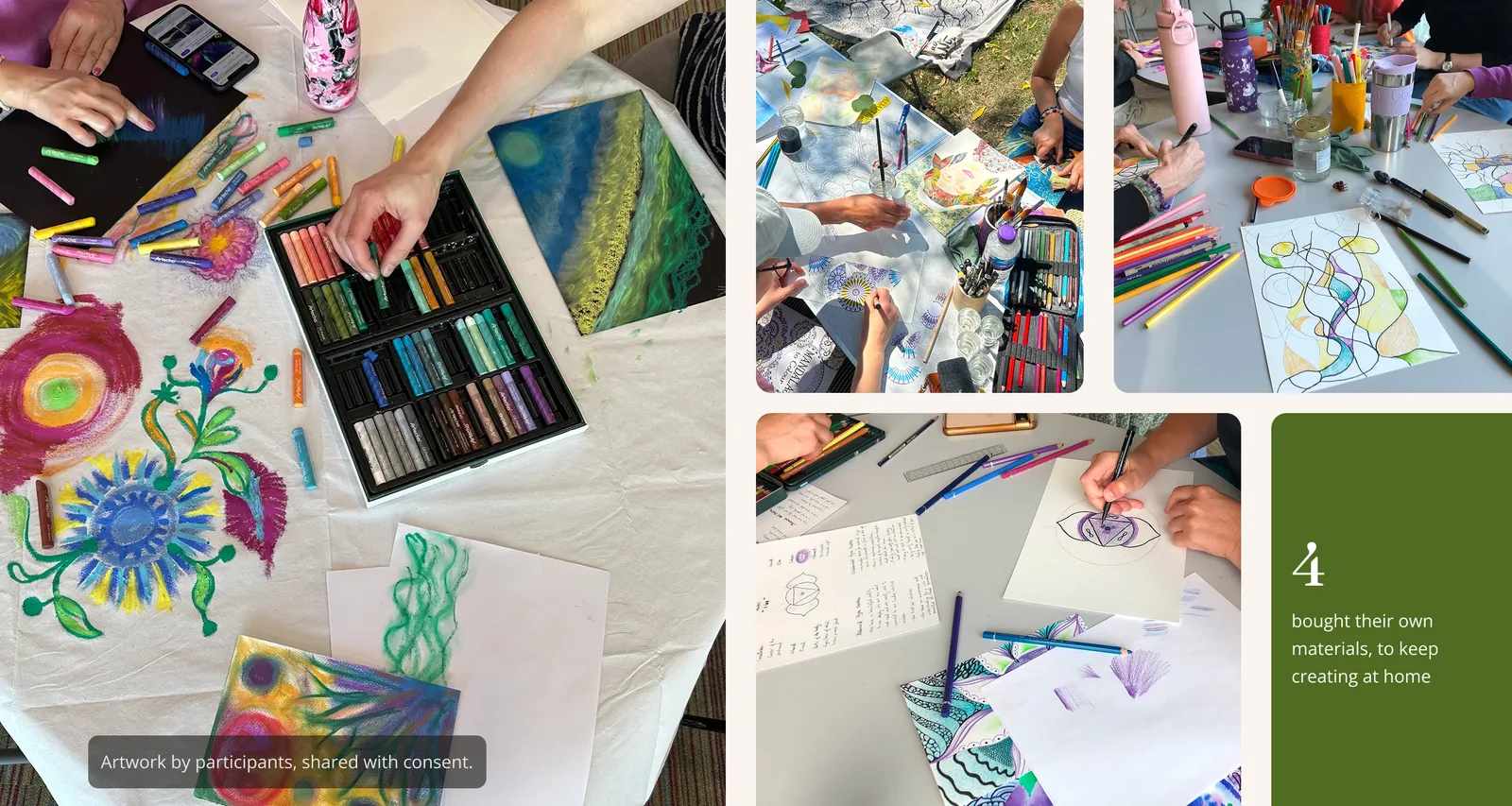
I recently had the pleasure of attending an art therapy session with Rocio, and it was truly an amazing experience. From the moment I walked in, Rocio's warm and gentle demeanor put me at ease. She shared some incredible techniques that not only helped me express myself creatively but also boosted my confidence in my artistic abilities. The session was filled with pure joy; I found myself completely immersed in the creative process. Rocio’s guidance was invaluable, making it easy to explore my emotions through art. I left the session feeling inspired and uplifted. So inspired, in fact, that I immediately purchased all the materials when I got home! I plan to continue this journey and incorporate art into my life regularly. I highly recommend Rocio's art therapy sessions to anyone looking to explore their creativity and enhance their emotional well-being.
Rocio was fantastic: supportive and attentive; and created a beautiful, relaxing environment with special energy. I was able to get into a state of flow that felt grounding and brought a sense of deep calm. I not only learned fascinating theories on mandalas and chakras but also picked up some new art techniques.
I took 2 sessions of therapeutic art with Rocio. I really loved both sessions. Rocio's beauty of spirit comes through in her easygoing approach to facilitating learning and wellbeing. I came away uplifted with material to contemplate. Thank you Rocio
Reflection
What I'd do differently
- A challenge sharpened the workshop, but its agenda was too full. A few days before, a fellow questioned whether harm mapping was the right approach. I used the challenge to clarify the goal and look for evidence. But choosing depth over pace meant we didn't reach the safeguard commitments or the horizon cards. Next time, I'd split it into two sessions.
- I’d measure from the first session. A short check-in on arrival and on leaving would let me show change, not just attendance.
- What’s next. I’m applying the four changes to sessions from October 2026, and I’m looking for a design team to run an online pilot with.
"I'm grateful for the trust participants put in me and the initiative. We are building a sense of community, self-expression and support. I learned that most of what keeps a session safe is decided before anyone picks up a brush."
Case studies